Canine Cognition
Exploring how dogs use information, solve problems and make decisions.
Through a series of structured games and assessments, we explore how individual dogs remember things, respond to human input and approach problems when the answer isn't immediately obvious. The tests are based on research by Duke University and delivered under Ford K9 certification.
There are no right or wrong results, and this isn't an intelligence test. The interesting part is seeing how they approach the problem, and understanding it from their perspective.
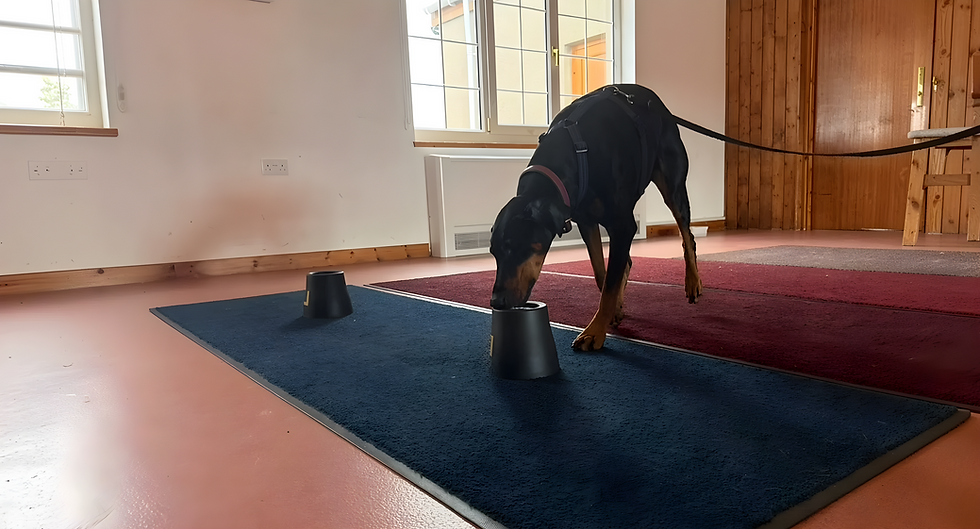
How does your dog think when they don't have all the answers?
That's where things get interesting.
Every dog has a default when the answer isn’t obvious. Some rely heavily on what they remember. Some look to their handler for information. Others are more inclined to make their own decision and crack on.
None of those approaches is inherently better than another. But they can have a big effect on training.
A dog with a strong memory, for example, might return to the location of a previous find rather than work the odour that’s actually there. A dog who looks to their handler whenever things get difficult needs something very different from one who barely notices the handler is there.
Knowing how your dog approaches uncertainty gives you useful information about how to train the dog in front of you.
Where do these tests come from?
These tests are based on research Cameron Ford has conducted with Duke University, including Professor Brian Hare and his team, into how dogs think, learn and solve problems. Ford K9 certifies the instructors who deliver this work, including in detection and operational dog selection.
Sam is certified by Ford K9 as a Canine Cognition Instructor, authorised to run these assessments, and has also completed Duke University's Dog Emotion and Cognition course, delivered through Coursera and certified by Professor Brian Hare.
How is the workshop structured?
The assessments use a series of simple, structured problems. The exercises themselves are deliberately straightforward, but the information available to the dog varies.
Day one begins with some theory looking at canine cognition, the different ways dogs can use information, the effects of arousal on learning and the influence handlers can have on decision-making, before carrying out the inference assessments with each dog.
Day two begins with the memory assessments before bringing everything together and interpreting the results.
Inference
Memory
How does your dog approach a problem when the answer isn’t immediately available? What information does the dog use to make a decision?
What information does your dog retain after a delay? What happens when memory and other information compete with one another?
After the workshop you will receive a written breakdown of your dog's results and a certificate of completion.
What can Cognition tell us?
Cognition testing gives us another source of information about the dog we're training.
.jpeg)
Understanding those tendencies can help us think more carefully about how we structure training, where handler influence may matter, when we might want to encourage greater independence, and whether the dog may be solving the problem in a different way from the one we intended.
Cognition testing doesn't give you a set of instructions for training your dog.
It gives you more information which will enable you to make better training decisions.
How to get involved
These workshops don't come around often, so don't miss your chance to take part.
Register your interest and we'll let you know as soon as the next one's open.